
September 29, 2026

White Rings and Rough Tile: What a Southern Utah Summer Does to Your Pool
Swim season is winding down in St. George, Las Vegas and Henderson, and a lot of pools have the marks to prove it. A white ring at the waterline. Tile that feels like sandpaper. Plaster that looked bright in May and looks chalky and blotchy now.
Most of that damage traces back to one source: the hard water that comes out of every tap in Southern Utah and Southern Nevada. A long desert summer concentrates those minerals in your pool and leaves them on the surface.
This post covers why desert pools take such a beating, the five signs your surface needs attention, what you can clean up yourself, and why ecoFINISH is the resurfacing option we recommend for pools in this climate.
Why Desert Pools Get Hit Harder
The water here starts out hard. The Southern Nevada Water Authority rates Las Vegas valley water at 280 parts per million, or 16 grains per gallon, which it classifies as “very hard.”
Then summer makes it worse. According to the SNWA, an average in-ground pool loses 48.6 gallons of water per square foot each year to evaporation. For a typical 470-square-foot backyard pool, that adds up to as much as 22,842 gallons a year.
Water evaporates, but the minerals stay behind. Every time the autofill tops off your pool, it adds another dose of calcium. By September, your pool water can carry far more dissolved calcium than it did in spring.
Heat speeds up the damage. Calcium carbonate becomes less soluble as water warms, so a pool sitting in the high 80s all summer pushes that calcium out of the water and onto the tile and plaster. Add a pH that drifts high and you get scale.
Five Signs Your Pool Surface Took a Beating This Summer
Walk around your pool this week and look for these.
- A white or gray line at the waterline. That crusty band on your tile is calcium scale. It builds up where water evaporates and leaves minerals behind, so it’s usually the first sign of hard water trouble.
- A rough, scratchy surface. Run your hand along the walls and floor. Plaster that feels like sandpaper, snags swimsuits or scrapes feet has either been etched by water chemistry or coated in a thin layer of scale.
- Stains that keep coming back. Brown, green or gray blotches often come from metals in the water or organic debris. Older plaster is porous, so stains soak in and return soon after you treat them.
- Chalky, faded color. Months of intense sun and chlorine wear down plaster pigment. If your pool looks dull and washed out even with clear water, the surface is breaking down.
- Pitting, cracks or hollow spots. Small pits, spiderweb cracks or areas that sound hollow when you tap them mean the finish is losing its bond with the shell. This damage spreads over time.
One of these on its own may just need cleaning and better water balance. Two or more usually mean the surface has reached the end of its life.
What You Can Fix Yourself and What Means Resurfacing
Some summer damage cleans up. Some of it is permanent. Here’s how to tell the difference.
| What you see | Try this first | Time to resurface when |
|---|---|---|
| Fresh scale line on tile | Scrub with a pumice stone or scale remover, then balance pH and calcium hardness | The line comes back within weeks, or the scale has bonded into the plaster |
| Light surface stains | Use a stain treatment made for your stain type (metal or organic) | Stains return after every treatment or cover large areas |
| Rough plaster | Brushing and balanced chemistry can keep it from getting worse | The whole surface feels rough; an acid wash strips off a layer of plaster, so each one shortens its life |
| Faded, chalky color | Nothing restores lost pigment | You’re unhappy with how the pool looks |
| Pitting, cracks, hollow spots | A pro can patch a small area | The damage is spread across the pool or keeps growing |
When the surface itself is worn out, more chemicals and scrubbing won’t bring it back. That’s when resurfacing makes sense.
Why ecoFINISH Is the Best Resurfacing Option for Desert Pools
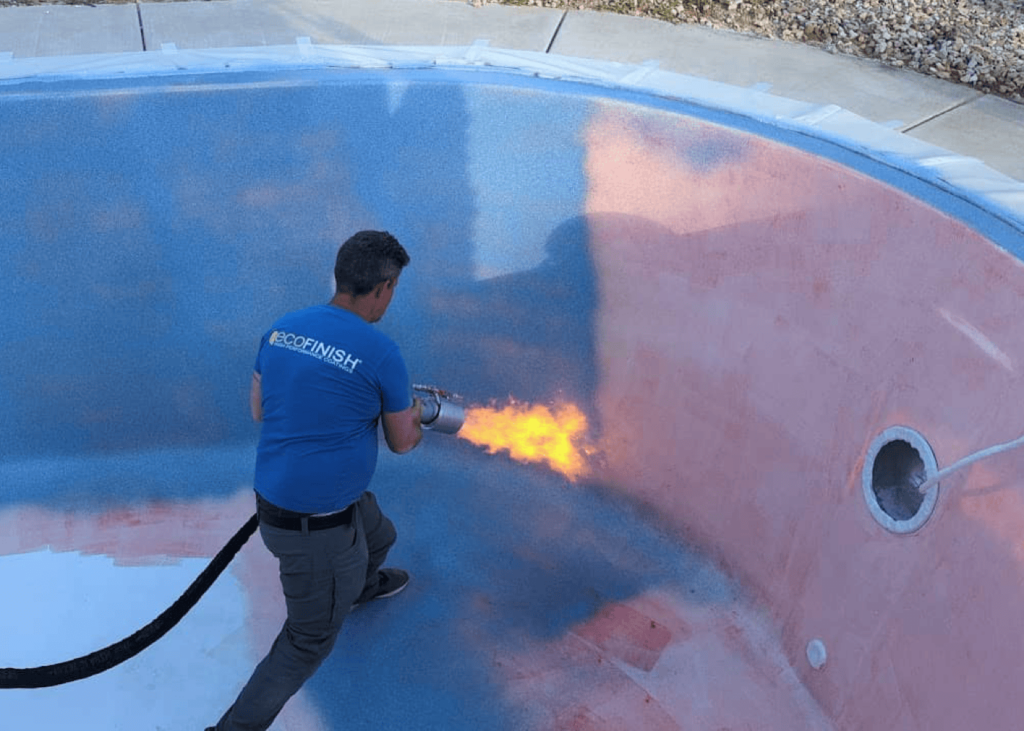
If you’re resurfacing, the finish you choose decides whether you’re back in the same spot in a few years. For hard water and extreme heat, ecoFINISH is the strongest choice available.
Plaster, quartz and pebble are all cement-based finishes. Plaster etches when chemistry drifts, and hard water leaves scale on quartz and pebble. ecoFINISH works differently. It’s a high-performance polymer coating that our crews flame-spray to your pool’s shell, forming a sealed, flexible barrier.
Here’s what that means for your pool:
- It resists scale. ecoFINISH has a smooth, pH-neutral surface built to withstand scale formation. Minerals have much less to grab onto, and buildup at the waterline wipes off more easily.
- It holds its color. ecoFINISH doesn’t chip, flake, peel, chalk, fade or blister, even under Southern Utah and Las Vegas sun.
- It stands up to chemicals and stains. The surface resists chlorine, stains and cracking, so blotches don’t soak in the way they do in porous plaster.
- It feels smooth. No more scraped feet or snagged swimsuits.
- It gets you swimming sooner. We can start refilling your pool within 24 hours after the final coat.
- It works on most pools. We apply ecoFINISH over concrete and plaster pools and use it for fiberglass pool resurfacing.
| Finish | Typical lifespan | How it handles hard water |
|---|---|---|
| ecoFINISH | 10+ years | Smooth, sealed surface built to resist scale |
| Pebble | 10+ years | Scale collects in the textured surface |
| Quartz | 10+ years | Prone to scale buildup |
| Plaster | 5 to 10 years | Etches and scales as chemistry shifts |
For more on lifespans, see How Long Does Pool Resurfacing Last in Utah? and Why ecoFINISH Coatings Are Perfect for Pools in Utah and Nevada.
No pool finish turns hard water into soft water. You’ll still want to keep pH and calcium hardness in range. With ecoFINISH, the surface does its part and stays smooth, bright and easy to clean.
Why Fall Is the Right Time to Resurface
The damage is easiest to see right now. Scale lines, rough spots and faded color are at their worst after a full summer, so it’s the best time to have us assess your pool.
The timing works in your favor, too. Swim season is over, so the few days your pool is out of service come after your family is done swimming. Crews work in mild fall temperatures instead of triple-digit heat.
The biggest reason is spring. Resurfacing calendars fill up fast once the weather warms and everyone wants their pool ready for Memorial Day. Book in the fall or winter and your pool is finished and waiting when the first warm weekend arrives.
Get Your Pool Ready for Next Summer
If your pool came out of this summer rough, stained or faded, now is the time to fix it. Polynesian Pools installs ecoFINISH for homeowners across Southern Utah and Southern Nevada, from St. George and Hurricane to Las Vegas and Henderson.
We’ll look at your pool, tell you what’s cleaning and what’s resurfacing, and give you a clear quote. Book this fall and your pool will be ready before the spring rush.