
June 11, 2026
Why Can’t You Reapply Fiberglass Pool Gel Coat? (The Real Fix)
You’ve probably heard it before. You call a pool company, describe how your fiberglass pool looks chalky, faded, or rough to the touch — and they hit you with a flat “sorry, can’t help you.” No explanation. No alternative. Just… no.
So what’s actually going on? And more importantly, is there anything you can do about your fiberglass pool gel coat besides live with it?
Let’s talk about it.
What Is Gel Coat, Anyway?
When a fiberglass pool gets made at the factory, the very first thing sprayed into the mold is gel coat. It’s a thick, pigmented resin that becomes the shiny, smooth, waterproof surface you swim against. It looks great on day one. Really great, actually.
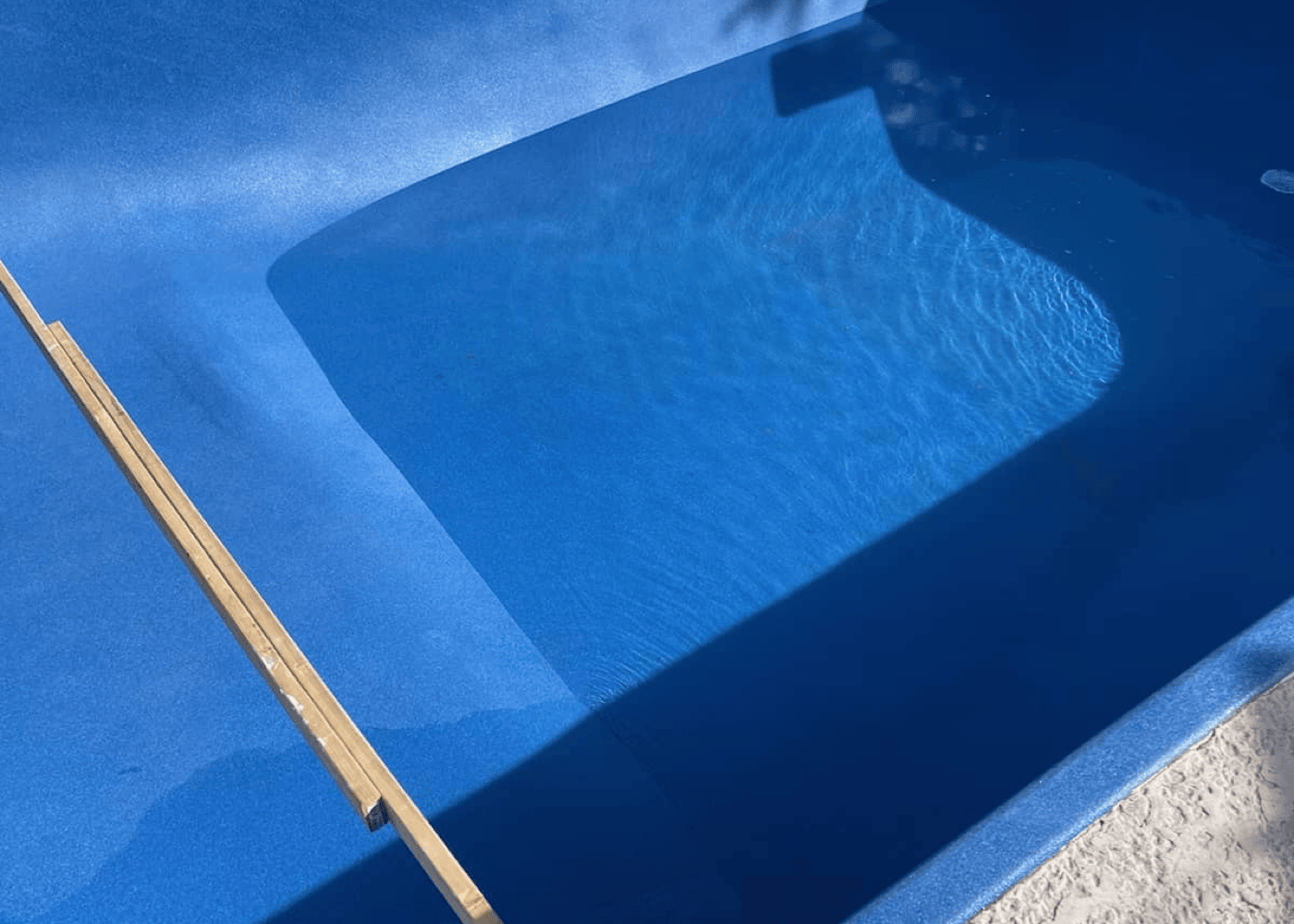
But gel coat wasn’t designed to last forever. After 10, 15, maybe 20 years of UV exposure — especialy in places like St. George or Las Vegas where the sun hits hard — that surface starts to fade. It oxidizes. It gets chalky. Sometimes it gets rough enough to scratch your feet.
And that’s when homeowners start asking: “Can’t someone just reapply the gel coat?”
Why You Can’t Just Reapply Fiberglass Pool Gel Coat
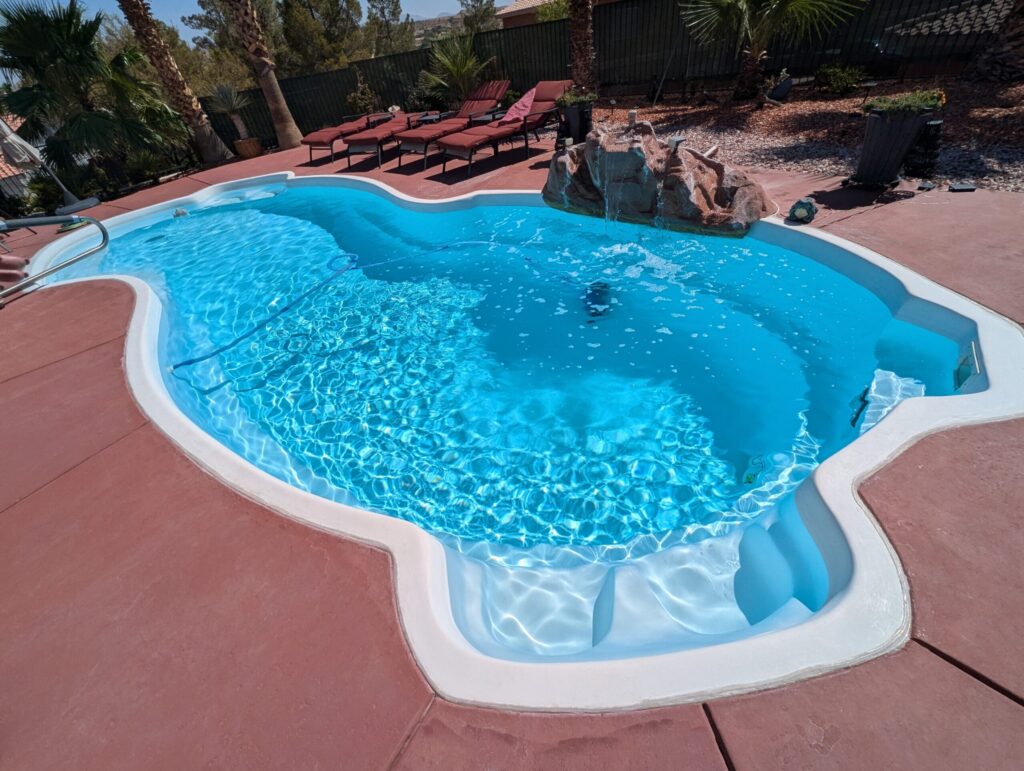
Here’s the thing nobody explains clearly: fiberglass pool gel coat can’t be reapplied in your backyard. Full stop.
The reason is the process itself. Gel coat is sprayed into a mold before the fiberglass layers go in. It bonds to the structure under controlled factory conditions — specific temperature, specific humidity, zero contamination. The mold is what gives it that smooth finish.
Your pool is a dug-out hole in the ground. There’s no mold. There’s no climate-controlled factory. There’s dirt and bugs and wind and pool chemicals soaked into the surface. Even if someone could spray gel coat onto your existing pool shell, it wouldn’t bond right. It would peel. It would blister. It would look worse than what you started with.
That’s why reputable pool companies say no. It’s not that they don’t want your money — it’s that they know it won’t work, and they don’t want to be the ones who have to explain why your pool looks terrible six months later.
What About Epoxy Pool Paint?
A lot of homeowners go this route when they can’t find a better option. And look, we get it. Epoxy pool paint is cheap upfront, it’s available at pool supply stores, and it makes the pool look fresh for a season or two.
But “a season or two” is really all you get.
Epoxy paint blisters. It peels in sheets. It traps moisture underneath and then bubbles up, especially in the heat. By year three you’re looking at a pool that honestly looks worse than the original faded gel coat — because now you’ve got chunks of paint lifting off the walls.
Then you’ve got to drain the pool, strip the old paint (which is a miserable job), and start the whole cycle over. It’s a money pit dressed up as a fix.
So What’s the Real Answer for Fiberglass Pool Resurfacing?
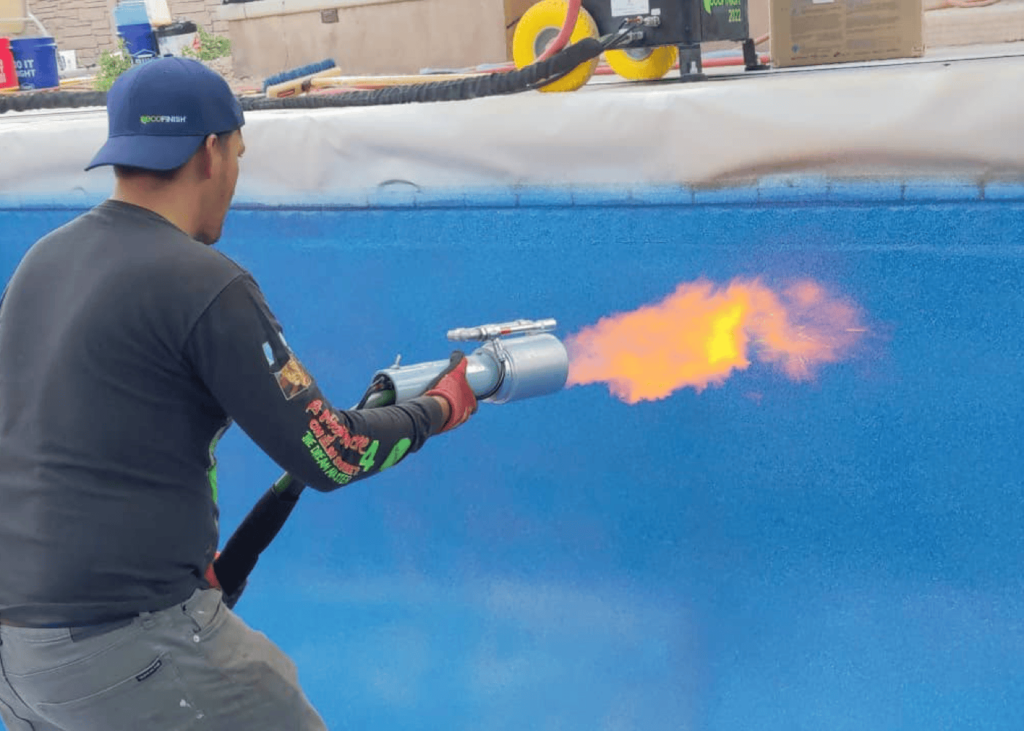
There’s a product called ecoFINISH — specifically the polyFIBRO line — that was built specifically for situations like this. It’s a polymer coating that gets applied using flame-spray equipment on-site. Not in a factory. Not with a mold. Right there at your pool.
The application process heats the polymer particles and fuses them directly to the pool surface. That’s what makes it different from paint. It’s not sitting on top waiting to peel — it’s bonded in a way that epoxy paint never achieves. And because it’s a polymer, not a resin like gel coat, it doesn’t need those factory conditions to cure correctly.
Here’s what makes it work for fiberglass pool resurfacing specifically:
- It bonds to fiberglass. The flame-spray process creates adhesion that outlasts traditional coatings.
- It’s UV stable. In Southern Utah and Nevada, that matters more than almost anywhere else. It holds its color under brutal sun exposure.
- It’s neutral pH. Unlike some coatings that throw off your water chemistry, ecoFINISH doesn’t leach into the water. Your chemical costs actually go down.
- The pool can be refilled the next day. No two-week cure time. No waiting around.
What Polynesian Pools Does Differently
Polynesian Pools, based out of St. George, Utah, is an ecoFINISH installer. We’ve been doing fiberglass pool resurfacing across Southern Utah and Nevada — serving Las Vegas, Henderson, Mesquite, Cedar City, Hurricane, and surrounding areas — for decades.
When we come out to resurface your fiberglass pool, we asses the surface, prep it properly, and apply the coating with the right equipment. The whole process typically wraps up in a week or less.
If you’re in St. George, Las Vegas, Henderson, or anywhere in Southern Utah or Nevada and your fiberglass pool is looking rough — or if someone already told you “we can’t do anything about gel coat” — it’s worth calling Polynesian Pools. Because the answer isn’t always no. Sometimes there’s just a better option nobody told you about yet.